Shu Yang

Shu Yang 杨数

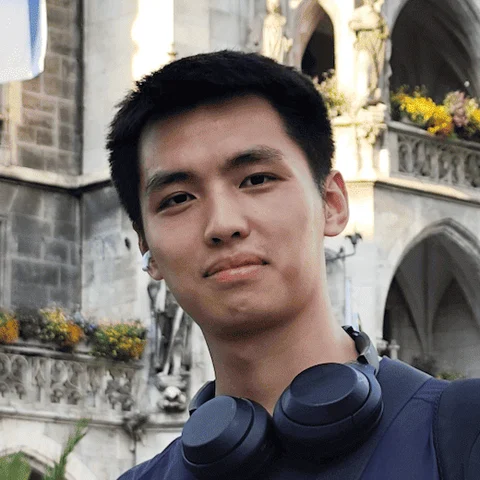
Portrait of Shu Yang

I simulate water, protons and quantum particles: at interfaces, under confinement, and on the way to ice.

PhD student · Michaelides group · Yusuf Hamied Department of Chemistry, University of Cambridge

Research

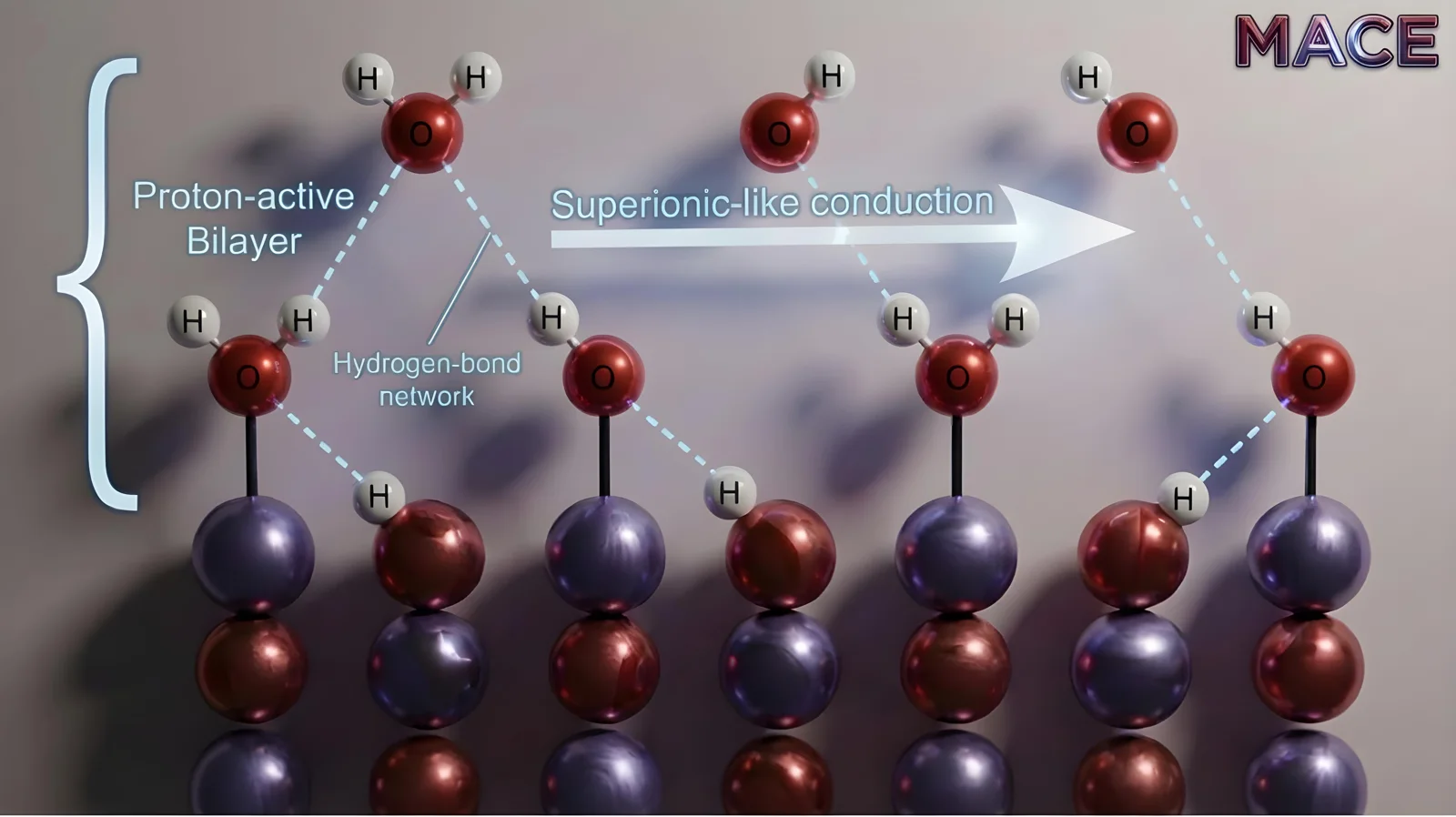
Rendering of the proton-active water bilayer on MgO, with protons hopping along the hydrogen-bond network
The proton-active water bilayer on MgO(100), simulated with MACE.

01

Molecular superionicity at the MgO–water interface

Can a thin film of water on an oxide surface conduct protons like a superionic material, at room temperature? I run machine-learning molecular dynamics at hybrid-DFT accuracy, with classical and path-integral nuclei, to follow hydrogen-bond dynamics and proton transfer at the MgO(100)–water interface. From the trajectories I compute sum-frequency generation spectra and proton conductivity, so the simulations can be compared directly with experiment.
MACE · PIMD / RPMD · SFG spectroscopy · proton transport

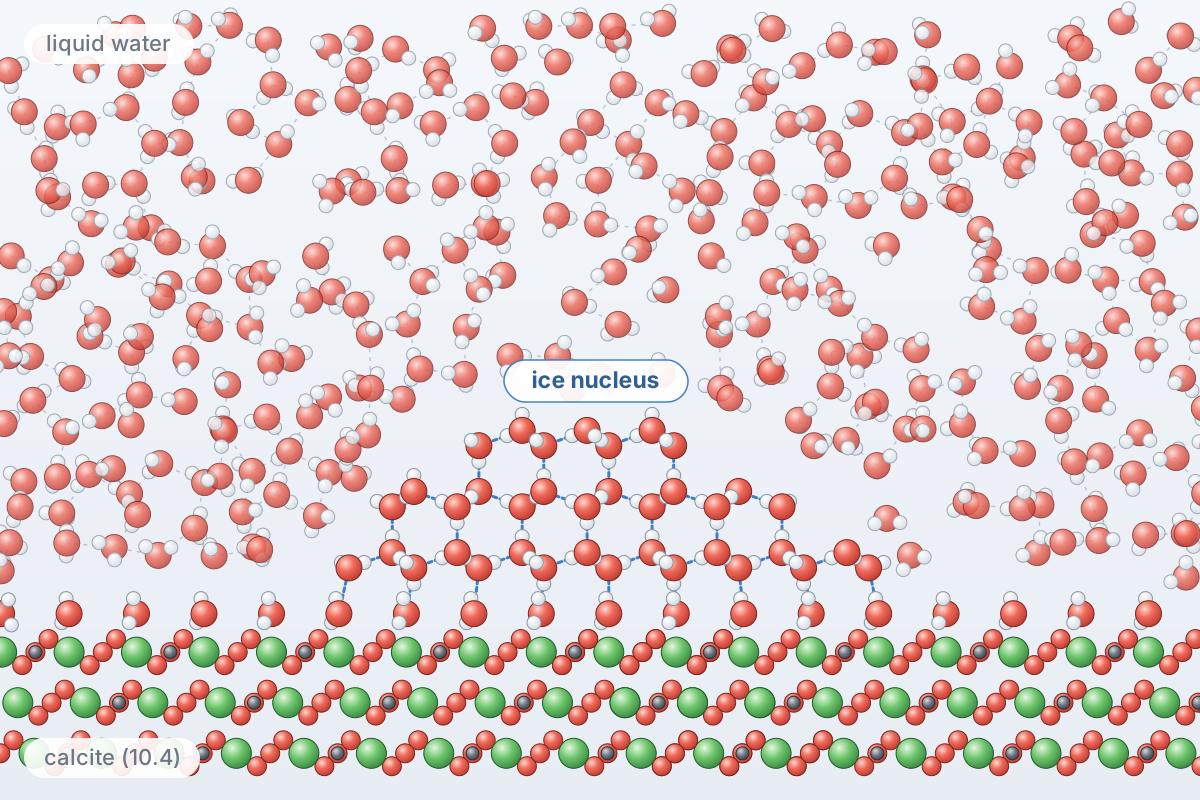
Schematic of an ordered ice nucleus growing on a calcite (10.4) surface inside liquid water
An ice nucleus on calcite (10.4) in liquid water.

02

Ice nucleation at interfaces

Ice nucleation is slow and rare: describing it well usually takes tens of thousands of water molecules simulated for tens of nanoseconds. Freezing at an interface is harder still, because the interaction between water and the surface must also be described accurately. Large, long simulations and high accuracy normally pull in opposite directions. Machine-learning potentials fill this gap, and I am using them to study how surfaces template the formation of ice.

heterogeneous ice nucleation · machine-learning potentials · interfaces

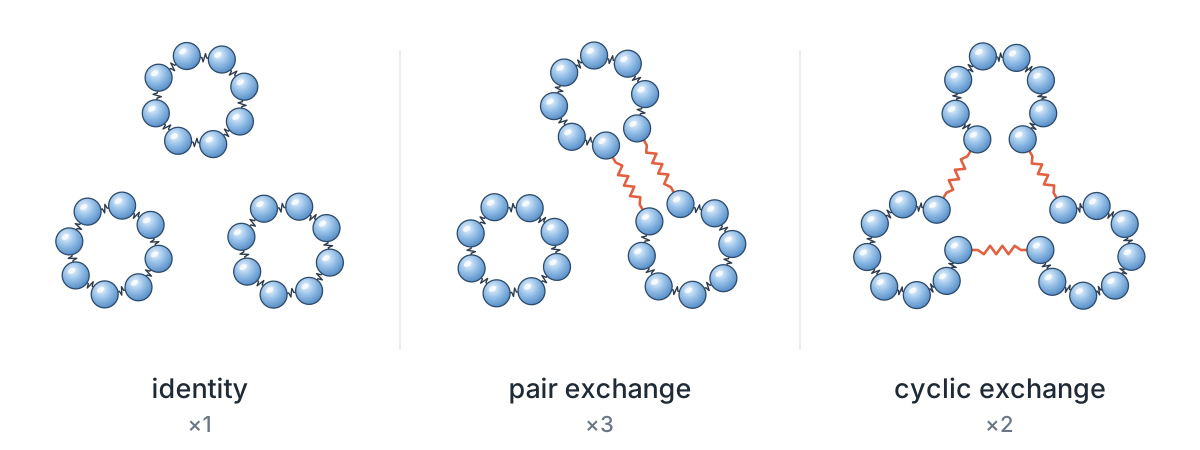
Ring polymers of three bosons with no exchange, a pair exchange and a cyclic exchange
Exchange configurations of three bosons as ring polymers.

03

Path-integral molecular dynamics for bosons

In path-integral simulations each quantum particle becomes a ring polymer; for bosons, the rings of identical particles can join into longer exchange rings. With Prof. Xin-Zheng Li I implemented open-path PIMD and bosonic PIMD in LAMMPS, applied them to liquid water and helium, and developed perturbative and open-PIMD-based approaches that make PIMD cheaper and give access to off-diagonal long-range order.

Open PIMD · bosonic PIMD · LAMMPS · liquid helium

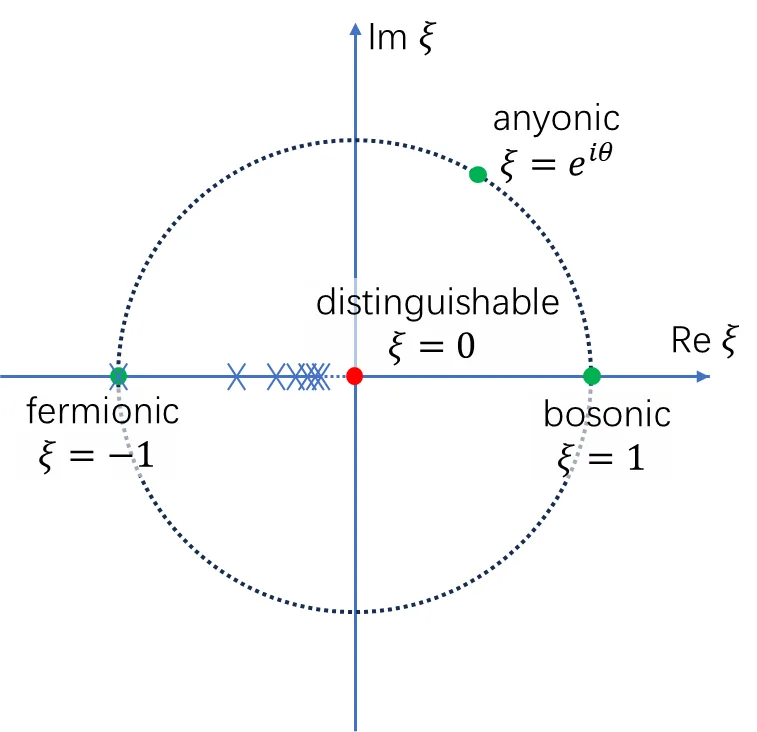
Complex plane of the exchange parameter xi, with fermionic, distinguishable and bosonic points and the zeros on the negative real axis
The complex ξ plane of the exchange parameter. From Phys. Rev. E 2026.

04

The fermion sign problem through Lee–Yang zeros

Fermion simulations suffer from the sign problem. Treating the exchange parameter ξ as a complex variable turns the partition function of indistinguishable particles into a polynomial; at 0 K its zeros sit at ξ = −1, −1/2, −1/3, … . Following how these zeros move with temperature gives a new view of where the sign problem comes from.

quantum statistics · partition-function zeros

Publications

* equal contribution

Conferences

Faraday Discussion “Molecular and ion flows through angstrom-scale channels”, Manchester, 13–15 April 2026

Background

Contact

Yusuf Hamied Department of Chemistry, Lensfield Road, Cambridge CB2 1EW, UK
sy483 [at] cam.ac.uk